Valdris

The game guide

Valdris

The world

An alliance, and what became of it

The Concord was an alliance of power: nine great houses who agreed to hold the line, and did, for an age. They built the straight roads that fissure the land, minted one coin so nine peoples could supply each other, and kept the peace between themselves — a quarrel at home meant a gap in the watch.

Seventy-one years ago the Concord was dissolved, and the hall of records was sealed from within. The alliance was gone — but the power, the great houses and their underlying disputes remain. Those that survived are still rich, and answerable to nobody. Years are counted from that night.

What the line was drawn against has become unclear all these years later — and what happened that night to bring the Concord down? The basin says a people out of the north, beaten and scattered long ago. The clans say it was never a people. Whatever it was, it has never been resolved, and some say it never left.
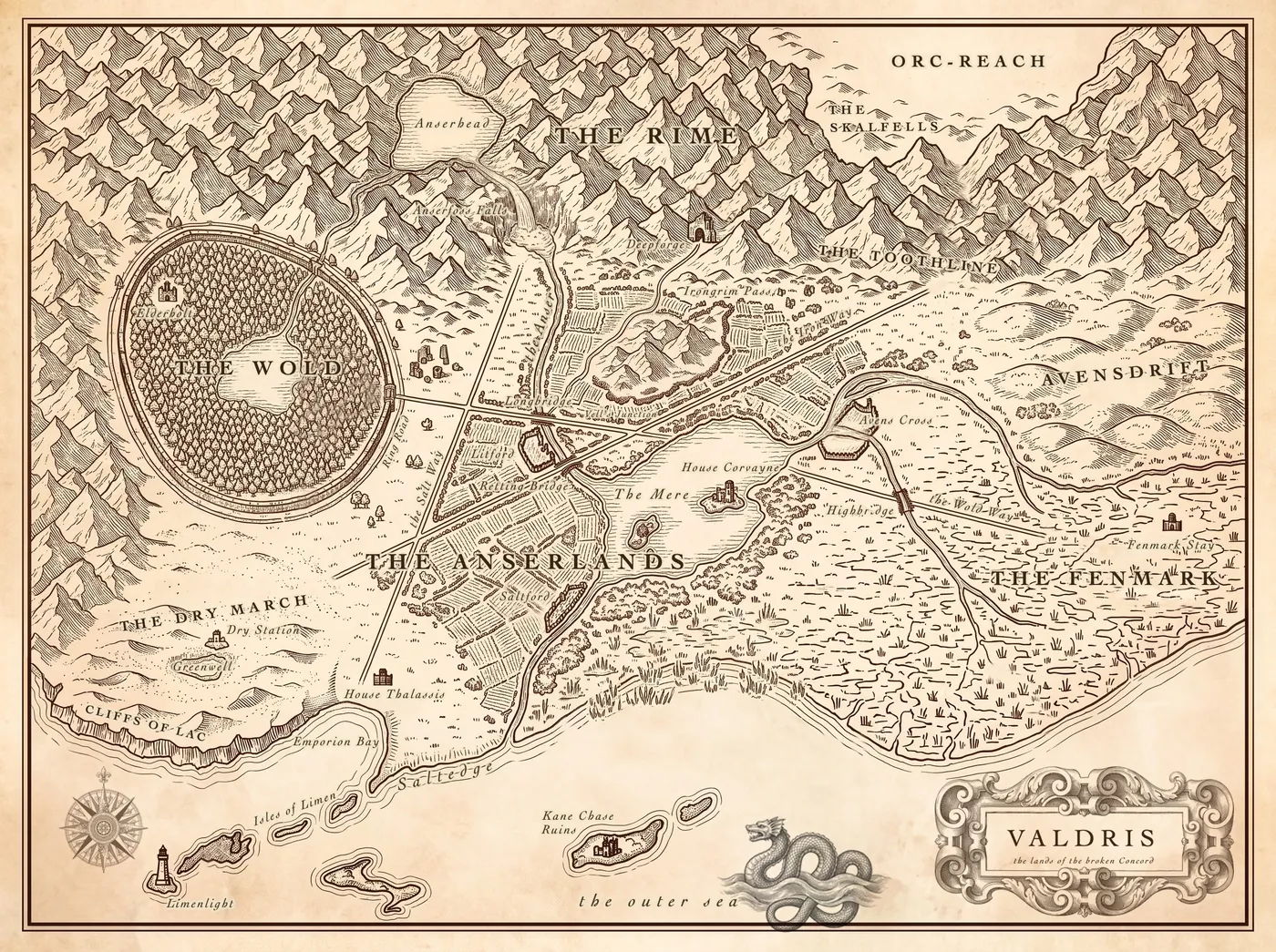
A drawn map of Valdris: the Anserlands at the centre on the river Anser, the Rime and the orc-reaches to the north, the Wold west behind its Ring Road, the Fenmark east, Saltedge along the southern coast, and the Dry March in the southwest.

The regions

The Anserlands

Farmland, mills and river cities along the Anser and the shores of the Mere. Everything but the desert borders it.

The Rime

Cold highlands and iron hills, clan country, walled off by the Toothline. The dwarves' deep halls lie beneath it; past the last clan-ground are the orc-reaches.

The Wold

Old-growth forest, ringed by the Ring Road the Concord raised so that no path would cross through it. Rumour says the elves still keep their ruins deep inside.

The Fenmark

A vast reed-marsh where the Anser's eastern tributaries drown. Insular, roadless, feared. People swear they see movement out in it, but nobody gets close enough to be sure.

Saltedge

The whole southern coastline, from where the Wold's Ring Road meets the water to the mouth of the Anser. The salt-flats are one stretch of it. The basin's only window on the wider world.

The Dry March

Desert, in the southwest. People go a little way in and come back — there is a station on the edge of it and an oasis past that — but nobody has crossed the interior, and nothing is drawn on the far side.

The Concord Ways

The straight roads that fissure the land, cracked but still walkable. Whoever holds a junction holds a chokehold.

Who holds what now

Nine seats were made; four still answer. The Nine were never the representatives who sat in the hall — they are these houses, whose money predates the Concord and outlived it. Most still hold what they were given, out of habit, having long forgotten what it was for — but holding it is enough. The grain, the iron, the salt and the roads all move at their say.

House Corvayne The Mere shore

Grain, mills, and the granaries three river cities eat out of in a bad winter. More importantly, they hold the way to the old seat: Ninehall stands on the island of Nineholm, and the only approach to it runs through their compound. The hall was sealed the night the Concord dissolved and has not been opened since. They hold the only record of the alliance.

The Deepforge Under the Toothline

Iron, all of it. Whatever the alliance asked the dwarves to watch was underground, and unlike every other house they never stopped watching it.

Elderholt Inside the Wold's Ring Road

Elvish, at the only place the basin and the deep forest actually meet. Something happened between the alliance and the elves; the maps were redrawn without the forest on them, with no record as to why.

House Thalassis Above the salt-flats, where the Anser meets Saltedge

Salt, and the coast roads it moves on. Regulates commerce across the Outer Sea.

The road-barons No house at all

Heirs of the old road-wardens, who have seized stretches of the old Concord Ways and toll them. No ancient claim, and no interest in pretending otherwise.

The river No house, and none wanted

From the upper Anser down to the Mere, trade runs on handshake agreements between wharf-masters, village councils and bargemen. Still working, like it did long before the Concord was formed.

Each exchange

You write a sentence. The world answers.

You describe what your character does the way you would say it out loud — check the tomb markings to see if the rumours are true, bribe the innkeeper and ask for details, hand over the sword on purpose and see what happens — and it is understood.

Who decides

The lore master writes; it does not adjudicate. Every attack, save and skill check is rolled and resolved by the game engine — your armour class, your hit points, the difficulty of the thing you tried. None of it is hallucinated. The story cannot talk the maths into being kinder, and you can see the rolls.

What it costs

A bad roll is not narrated away. Money runs out, wounds carry between scenes, an offer you refused is not always offered twice, and people who watched you do something remember that they did. A failure can be a near miss — and the lore master can choose to give you that, or not.

What is kept

Your inventory, injuries, reputation, and everyone you have met are recorded properly rather than held in a model's memory and hoped for. Come back in three weeks and the country is where you left it, minus three weeks.

There is no win condition. Nothing is on rails, and the world does not pause between your visits.

Your character

Made in conversation, forged in ink.

There is no sheet to fill in. The lore master asks about you and you simply respond: a dwarf who ran iron down from the halls until an argument made that impossible. That is enough to build on, and it is remembered later by people who were not there when you said it. If you would rather not invent anything, say surprise me and you are handed a whole traveller, past and all.

Five classes

Fighter — you carry a longsword, chain mail and a shield, or a greataxe and the decision not to bother with one. You are the one still standing when it has gone badly, and you do not need anybody's help to get back up.

Ranger — a longbow, studded leather, and a fletcher's kit you keep in order. You find the way through and you see it before anyone else does. You have hunted beasts long enough to know where the living come apart.

Rogue — a shortsword, leather, thieves' tools. You are worse in a fair fight than anyone else, which is precisely why you do not intend to be in one.

Mage — a spellbook, a component pouch, a dagger you would rather not need, and no armour at all. What you throw lands harder than the book says it should.

Cleric — a mace, a chain shirt, a shield, and a holy symbol that means something specific to somebody. Once in a fight you can call on something that does not care what the odds were.

And a past

Be you a soldier, hunter, charlatan, sage, acolyte or criminal — or maybe something else entirely? Your background sets what you are already good at, what you kept when you left, and who might still recognise you.

Five peoples

Not cosmetic. Where you come from opens some doors and shuts others — a dwarf gets a hearing in the deep halls where a farmer's son would wait a season, a halfling has cousins on every wharf between the Rime and the Mere, and a half-orc on a basin road is judged before he speaks.

Human — the basin's own. Practical, stubborn, everywhere, and everywhere assumed to belong. Doors open for you that you never noticed were doors.

Elf — out of the realm behind the Ring Road, which the basin knows as a rumour with a face. You keep your own time, and you are very hard to influence or manipulate.

Dwarf — delving-folk from under the mountains, older than the alliance and outlasting it without much noticing. You can tell what a wall is holding up by looking at it, and iron does what you tell it.

Halfling — river people, running the trade the cities live on. Warm, wry, and always talking, and there is nowhere on that water you cannot find a bed and a boat.

Half-orc — border-born, out of the cold reaches. You go further than you ought to be able to, carry more than you ought, and are still going long after the rest have sat down.

Getting better

Skills grow into verbs, not into bigger numbers

Most games hand you a larger modifier and call it progress. Here, using skills over time unlocks something you could not do at all before — a named capability, announced when you earn it. Once learned, some are yours to declare; others simply start happening. Skills are part of what brings the character meaning.

The full list is in the game. Here are a few of our favourites:

Silver tongue → Negotiator → Sway

Talk past a wary listener. Then find the deal both sides can live with. Then win over a hostile crowd, or change a made-up mind.

Slip → Vanish → Ghost

Move unseen through cover even when partly exposed. Then break line of sight mid-scene, while watched. Then cross an occupied room unseen and set up the opening strike.

Grapple → Throw → Overpower

Hold a foe your own size. Then hurl an off-balance one. Then break the grip of something larger than you, and clear gaps others can't.

Nobody assigns you these. They grow out of how you play and how your character deals with the world — shaped by their class, their people and their past — which is why two players who both reach the same level are rarely capable of the same things.

There are eighteen skills and fifty-four capabilities behind them. They are not listed here on purpose: finding out what you have become is part of the pleasure.

Now you know the country

The rest of it only happens if you walk in.

Valdris is in alpha, and we would rather it be good than crowded.
We are letting people in as fast as we can. Free to begin.